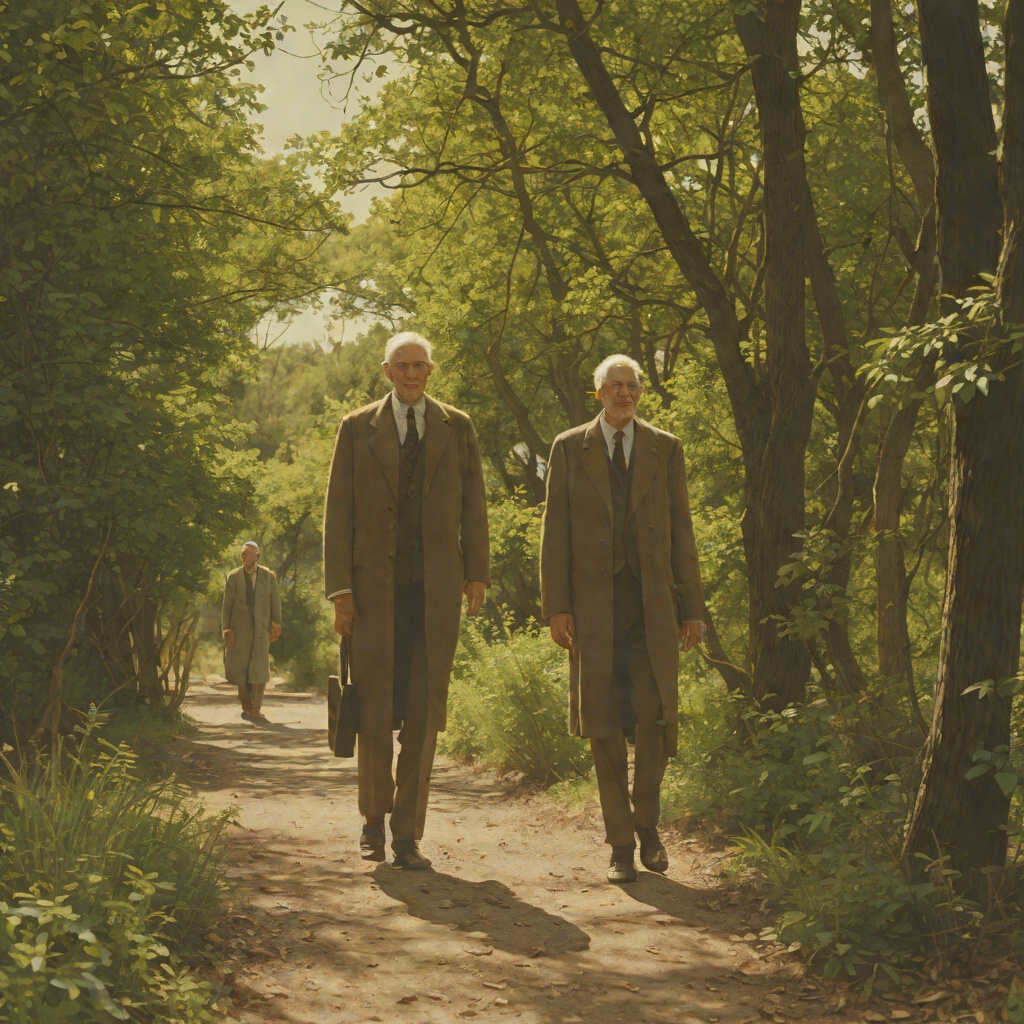
The Decision
The Unlikely Pilgrimage of Harold FryThe Decision is the hinge upon which the entire novel turns: the moment Harold Fry, a sixty-five-year-old retired man who has never walked farther than to his car, commits to walking the length of England to keep his dying former colleague Queenie Hennessy alive. It is a decision made without deliberation or reasoning, arriving in the same instant as the idea itself, and it transforms what began as an errand—posting a letter—into an act of faith that will carry him nearly six hundred miles from Kingsbridge to Berwick-upon-Tweed. The decision is not merely the plot's inciting incident; it is the novel's central statement about the power of belief, the weight of the past, and the possibility of redemption through a single, seemingly absurd commitment.
The Genesis of the Decision
The decision crystallizes in a phone box, not in a moment of clarity but in a surge of feeling. Harold has just learned from a hospice nurse that Queenie is asleep, and for a heartbeat he believes she is dead—his spine chills and he clamps his knuckle to his mouth. But the nurse's voice clarifies that she is merely resting, and in that reprieve, something shifts. Standing at one end of England, he pictures Queenie dozing at the other, with all the unknown country between them: roads, fields, rivers, woods, moors, peaks and valleys, and so many people he would meet and pass. The decision comes in the same moment as the idea; there is no deliberation, no reasoning. He is laughing at the simplicity of it. He tells the nurse to deliver a message: Harold Fry is on his way, and all Queenie has to do is wait, because he is going to save her. He will keep walking, and she must keep living.
This spontaneity is essential to the decision's character. It is not a calculated plan but an instinctive, almost childlike leap—the same childlike quality Maureen will later recognize and resent. When Harold phones his wife from a smelly phone box outside a pub, she is thrown by his certainty. She reminds him he is sixty-five, that he only ever walks to get to the car, that he has left his mobile phone behind, and asks where he thinks he will sleep. His reply is stripped of laughter: he does not know, but it is not enough to post a letter. He needs to do this. The way he appeals to her, adding her name at the end as if the choice were hers when he has clearly already decided, ignites her anger. She tells him to head off to Berwick if that is what he wants, and wagers she would like to see him get past Dartmoor. The line cuts off before she can finish.
The Decision as a Covenant
The decision immediately takes on the force of a sacred vow. Harold's message to Queenie—that she must wait, that he will save her—becomes a covenant with life itself. The nurse at the hospice later confirms the extraordinary power of this promise: Queenie is waiting, just as he said she should. The nurse admits she had feared Harold misunderstood the gravity of the situation, but she was wrong; it is a rather unusual kind of healing. Her words crystallize the novel's philosophy: a little less sense, and a little more faith. The decision, born of unreason, proves more potent than any rational calculation.
This covenant reshapes Harold's perception of reality. Once he is on the road, he no longer sees distance in terms of miles; he measures it with his remembering. The decision unlocks the past he has spent twenty years avoiding, and it chatters and plays through his head with a wild energy of its own. Walking becomes a form of excavation: he sees Maureen in the front garden of Fossebridge Road, digging in French-bean plants; he recalls the fragility of David's head when he was born; he hears the hollow cackle of a crow and is suddenly a teenager lying in bed, overwhelmed with loneliness. The decision does not merely set him walking; it sets him remembering, and the two become inseparable.
The Decision's Evolution and Testing
The decision is not static; it must be renewed and defended against doubt. On the twenty-sixth day, six miles south of Stroud, Harold nearly abandons it. He has made a serious error about his direction, retracing five miles to Bath and walking four more days along the A46, and the mistake deeply disturbs him. The road never stops and never yields its promise; it takes every scrap of himself to keep moving when he knows in his heart he cannot make it. He questions why he wasted so much time looking at the sky and the hills, talking to people, thinking about life, when he could have been in a car. He tells himself Queenie cannot keep living just because he told her to do so. He feels more lonely and left behind than he would have done up a faraway mountain.
What saves the decision is a recognition of its true stakes. Harold realizes he is not only thinking of himself: there is Maureen, whom he misses more and more, and David, from whom he feels a painfully long distance. He has already caused them too much sorrow. And there is the practical matter of money—the guesthouses have been cheap, but he cannot afford to keep spending. He checks his account at the bank and is shocked. He resolves that if Queenie is still alive and interested in a visit, he will take the train and be in Berwick by the evening. He phones the hospice to make the call, and it is this near-abandonment that produces the revelation: Queenie is alive, she is waiting, and the nurse tells him about the unusual healing his walk has inspired. A cry of joy shoots out of him; he throws open the door of the kiosk and punches the air.
The Decision's Principles
Having recommitted, Harold articulates the principles that will govern his walk. He must remain true to the feeling that inspired him in the first place. It does not matter that other people would do it differently; in fact, this is inevitable. He will keep to the roads because, despite the odd fast car, he feels safer there. It does not matter that he has no mobile phone, no planned route, no road map. He has a different map, one made of all the people and places he has passed. He will stick to his yachting shoes because, despite the wear and tear, they are his. He sees that when a person becomes estranged from the things they know, strange things take on a new significance, and it is important to allow himself to be true to the instincts that make him Harold, as opposed to anyone else.
This philosophy extends to how he lives on the road. After his first night in a barn, Harold continues to sleep outside, choosing dry places and being careful not to upset things. He washes in public lavatories, fountains and streams; he rinses his clothes where no one is watching. He thinks of that half-forgotten world lived in houses and streets and cars, where people eat three times a day, sleep by night, and keep each other company. He is glad they are safe, and glad too that he is at last outside them. He takes A-roads, B-roads, lanes and tracks, following the compass northwards, going by day or by night as the mood takes him. If the blisters are bad, he binds them with duct tape. He sleeps when the need comes, then returns to his feet and walks again. It seems to Harold that he has been waiting all his life to walk.
The Decision's Deeper Roots
The decision's power derives from what it forces Harold to confront. The past he has buried—the suicide of his son David, his own alcoholism, his complicity in Queenie's firing—surfaces with unbearable clarity. Walking toward Queenie, he is forced to relive the afternoon he drove Maureen to the funeral director's to see David one last time in the coffin. She had packed a red rose, a teddy bear, and a pillow to go beneath his head. In the car, she asked Harold what he was going to give, knowing he had nothing. The sun shone very low, torching his eye as he drove; they both wore sunglasses, and even at home she did not take them off. At the funeral director's, she said she wanted to say goodbye to David alone. Harold sat outside with his head in his hands, waiting his turn, until a passer-by stopped to offer a cigarette and Harold took it, although he had not smoked since the days on the buses. His fingers shook so hard the passer-by used three matches to light it.
The decision to walk is thus also a decision to feel. Harold's journey is an act of atonement, a way of carrying the weight he has spent twenty years avoiding. He learns that it is the smallness of people that fills him with wonder and tenderness, and the loneliness of that too. The world is made up of people putting one foot in front of the other; a life might appear ordinary simply because the person living it has done so for a long time. He can no longer pass a stranger without acknowledging the truth that everyone is the same, and also unique; and that this is the dilemma of being human. The decision, which began as a spontaneous impulse in a phone box, becomes a way of being in the world—a commitment to presence, to listening, to faith. It is, in the end, the decision to become a pilgrim.